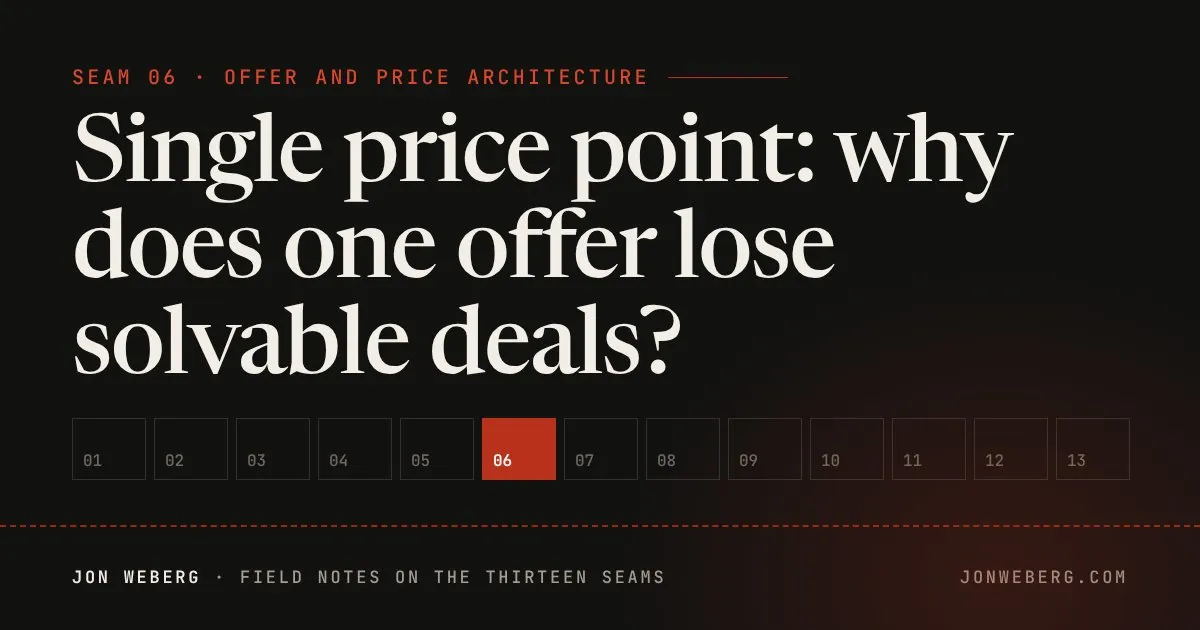
Single price point: why does one offer lose solvable deals?
Updated 2026-11-19
One offer at one price loses solvable deals because a sales call can end in only two outcomes, yes at that price or no, so every buyer who wants the result but cannot do the number leaves with nothing. As head sales consultant to Frank Kern, consulting on his sales process, Jon Weberg saw one $2,500 offer to buyers who had said no to an $8,600 program pay $41,253 in three days, and he diagnoses the gap inside offer and price architecture, so how many of your last 20 losses said price?
A single price point leaves a sales call with two outcomes, yes or no.
In more than 3,400 buyer interviews, confusing pricing structure contributed to over 40% of deals lost on price, and budget limits to under 10% (Klue, 10 Oct 2024).
On Kajabi, single offer experts had typical all time earnings of $180 against $82,212 for experts with ten or more offers (Kajabi, 5 Aug 2026; correlation, not cause).
One $2,500 offer for buyers who said they could not afford an $8,600 program paid Frank Kern $41,253 in three days, with no new ad spend.
The first missing outcome is a smaller version written for the buyers who said no on price, offered only after the no.
Your buyer says she loved every minute, your closer thanks her, the CRM marks the deal lost, and you have heard "I loved it, I just can't do the number" more than once this quarter, haven't you?
Why does a business with one offer at one price lose deals it could have closed?
A single price point gives the call two outcomes, so a buyer who wants the result but cannot do the number has nowhere to go but no. The Thirteen Seams records the sentence closers repeat: "They loved it. Couldn't do the number."
That buyer was qualified, wasn't she, she wanted the result and said so, and the obstacle she named was the one your call had no answer for, which is the no with nothing to say next, so of your last 20 qualified losses, how many said price, and what did your closer offer them next?
How many outcomes can your sales call end in?
Count the outcomes your closer can offer before the call ends; with one offer at one price, the count is two. On Kajabi, experts with a single offer had typical all time earnings of $180, against $82,212 for experts with ten or more offers (Kajabi, 5 August 2026). Kajabi's co-CEO notes the link is correlation, not cause, since catalogs grow as experts succeed.
Call outcome | One price point | With a smaller version |
|---|---|---|
Wants it and can pay | Yes at the flagship price | Yes at the flagship price |
Wants it, cannot do the number | No | Yes to the smaller version |
Does not fit | No | No, routed to the seam before the call |
How many outcomes can a call on your calendar today end in?
Is price really why you lose deals?
Price is the stated reason more often than the real one, and pricing structure is a bigger cause than budget. Buyers who say "too expensive" often mean they did not see the return, or that the pricing model, contract terms or payment timing did not fit their cash flow. Across more than 3,400 buyer interviews, confusing pricing structure and model issues contributed to over 40% of deals lost to price, value and ROI concerns to 22%, and budget constraints to under 10% (Klue, 10 October 2024).
Klue sells win loss research, and no independent figure for high ticket services was found, yet if structure outweighs budget four to one, which part of your structure did your last lost buyer stumble on, the total, the timing or the size of the commitment?
How do you tell a price loss from a fit loss?
Tag every lost deal within 24 hours with one reason, and ask one question: would they buy a smaller version of the same result today?
Question | If yes | If no |
|---|---|---|
Is the stated reason price? | Ask the next question | Tag fit, timing or trust |
Do they still want the result? | Price loss | Fit loss |
Would they buy a smaller version today? | Offer the smaller version | Ask about a payment structure |
Does budget exist later? | Payment structure or a dated follow up | Close the file |
Read your last five loss notes against the four questions, and in about 90 seconds two may read price loss, so how many of last quarter's losses would say yes to a smaller version if someone asked within 24 hours?
What should the first extra outcome be?
The first extra outcome is a smaller version of the flagship result, priced for the buyers who said no on price. This is the downsell done properly: a separate offer with a lighter scope, a tiered package or a feature lite version, never a cut to the flagship price, and in December 2021, buyers of Frank Kern's $8,600 program who said they could not afford it were offered one $2,500 offer, which paid $41,253 in three days with no new ad spend. Frank Kern has hired Jon Weberg four more times since.
Those buyers had already said no and the ads had already run, and one offer written for that pool turned polite goodbyes into $41,253, which the Frank Kern case study lays out step by step, so if buyers of an $8,600 program paid that for a $2,500 version, what would your lost buyers pay for the smaller version of your result? Build one rung first, using building an offer ladder as the guide, or have the AI Seam Architect install write it with you, from $30,000 for one seam, guaranteed at 10X ROI on the fee, conditioned on proper tracking and reporting.
Click the button at the end of this page (about 30 seconds).
Choose a time and bring your last 20 qualified losses with their stated reasons (about 10 seconds).
Confirm, and on the 45 minute call your price losses are counted and the first extra outcome is named.
Does a smaller offer cannibalize the flagship?
It does when it is offered before the flagship; it does not when it is offered only to buyers who already said no.
Your flagship keeps its price and pitch, the smaller version appears only after the no, and the next buyer who says "I loved it" leaves with a $2,500 yes in place of a goodbye, so what does that buyer leave your call with today?
Who owns the price decision when a deal is lost?
Nobody: the seam sits between the sales team and whoever sets the offer and price. The Thirteen Seams files it as Seam 06, offer and price architecture.
Your closers report the loss and your founder sets the price, and the revenue seam between them is the lost deal note nobody reads twice, so when did your price last change, who decided it, and who on your team reads those notes the day after the call? Nobody owns that number after the call, do they?
What does an AI employee do with a lost deal?
An AI employee tags the reason, sends the matching offer within hours and hands a person any buyer who replies.
It reads the stated objection from the call notes, picks the approved version from your offer ladder, writes to the buyer the same day and passes every reply to your closer, the job of an AI second offer employee, which never creates a price or a discount of its own, so Tuesday's "I loved it" hears the smaller version by Tuesday evening.
The clearest example Jon gives of a second outcome is the Frank Kern downsell, $41,253 in 3 days from buyers who had said they could not afford an $8,600 program, which he told in full on Your Business Growth Podcast with Jeremy Shapiro.
Frequently asked questions
Does a cheaper offer hurt the flagship?
Not when it is offered only to qualified buyers who already said no on price. They were not buying the flagship either way. Offer it after the no, never in place of the flagship pitch.
Should you lower your price to close more deals?
No. Lowering the flagship price cuts margin on every buyer who would have paid it. A second outcome for the buyers who said no keeps the flagship price and adds revenue from losses.
How many offers does a coach or consultant need?
Two to start: the flagship and one smaller version for price losses. Kajabi's value ladder advice is two rungs, with a third when the business asks for it (5 Aug 2026).
Is a payment plan a second outcome?
Yes. A payment structure changes when the money arrives without changing the price. It fits buyers whose obstacle is cash flow, while a smaller version fits buyers whose obstacle is the total.
What if most losses are fit, not price?
Then a second outcome is not the first fix. Route fit losses to the seam before the call, Seam 04, where a disqualified lead gets its own next offer, as in what to sell the lead you disqualified.
Bring your last 20 qualified losses with their stated reasons, and leave with your price losses counted and the first extra outcome named: Install My AI Seam Architect
Jon Weberg is the founder of Profitalize and the originator of The Thirteen Seams, a revenue diagnostic that finds the money a company loses in the handoffs between its teams. About Jon Weberg